| |
I had researched fiberglass repair shops in my area and came up with two likely outlets. The first I'm not going to spend any time on because their price was six times higher than D&R Motorsports. When I contacted Chris Long he was, admittedly, a little skeptical. I can't say I blamed him. While he'd done insurance repairs on boats before, this is the first hovercraft he'd ever touch. So, on a rainy day in which I had to work, my dad was gracious enough to take the hovercraft to have it examined. |
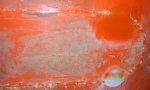
Not only did Chris come in under-budget AND at the price he quoted, he also found another small crack in the same location on the adjacent corner of the hull and repaired it as well. The repair took less than a week and looked fabulous. He was also kind enough to inform me of a few things about the fiberglass hull and the paint job I was unaware of. I can't begin to express my gratitude to Chris and his shop for performing a beautiful job on my machine.
Well, as you've, no doubt, figured out the pattern by now, some more time passed. In the interim, however, I was busy trying to hunt down information on this and that. Of particular concern was the colour of the paint. While most fiberglass, especially on boats, is gel-coated, Chris had informed me the Hurricane had simply been painted, which was not uncommon for a machine of my vintage. Since I was restoring the hovercraft, I decided to stay with simple painting which 1) makes the job much easier for me and 2) maintains a weight savings as gel-coat has some heft to it.
| My job then (and currently) is at a John Deere dealership. Why, you ask, do I bring this up? This is important because it is where I found a match for my paint. But aren't all Deere's green? Well, yes, technically, but for a few years they produced a tractor under the Scotts name which was a nice orange-red. While the tractors have (fortunately) long since been out of production, the paint is is almost an exact match for the Hurricane. I took a chance and brought a can of this home to spray on the section Chris had repaired. After drying, the only way you can tell it's not original is because, unlike the rest of the paint, it's shiny. |  |
With a source of paint available to me, restoration can move forward. I can buff out the rest of the paint, replace the decals, replace the skirt, ride it around...but I feel like I'm getting ahead of myself and forgetting something. Oh, yes, that's it. I'm forgetting the HOLES which...are...everywhere. Bottom, sides, top, you name it. Everywhere you look, something was screwed into something. I understand the Hurricane was hand-made but in the bottom of hull alone, there were 99 holes which had either been filled with silicone or were the screw holes for the skirt. Ninety-nine. WTF?
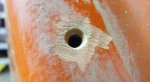 |
As much of a pain this many holes is, finding and repairing them properly will only add to the integrity of the hull and give me peace of mind. Many of the screw holes were enlarged and had a lip on them like a volcano where they pulled on the fiberglass. Using a "rotary tool" and a cone shaped bit, I removed the lip and slightly enlarged the holes while giving them a cone-shape. Into these, I had originally considered filling with fiberglass and resin. After doing some research I found a product called Marine-Tex, an epoxy-based filler, which had excellent reviews. While creating a water-tight seal, it is also sandable, drillable, and paintable - all features I was looking for. |
| Alas, a good supply of Marine-Tex was not in my possession, and there are only a few locations in Columbus which carry it. Regardless, the night was quickly advancing and I'd had my fill of holes. With another side to do, not to mention the areas where the lights and cleats were mounted, I decided to call it a night. The bottom holes were prepped and the silicone (oh, the silicone!) had been removed. The last thing I wanted to get done was wash the bottom to clear away the fiberglass dust and three decades of dirt. Ten minutes with the pressure washer yielded results I was pleased enough with to finally put the Hurricane away. Now, to fill all the damn holes.... | 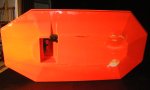 |
 Back |
 Next |